Joel Bradish Nichols –– art of passion, language of love
Updated: Jul 2

For an artist to return to painting after life‑altering injury is to witness the human spirit at its most unguarded. In such a moment, understanding the forces that carry you back to the page becomes all‑important, and in Joel Bradish Nichols’ case, the answers lie in the people and pursuits he had cherished.
In a coma for months after a near‑fatal accident, his re‑emergence into artistic practice becomes inseparable from a narrative of devotion and determination — a surrounding spiritedness that held him through the darkest hours.
I was delighted to be invited by his widow, Thessy Schoenholzer Nichols, to write this tribute to the late Joel Bradish Nichols for an exhibition catalogue in his honour. As I trace the trajectory of his life’s work and passions, what shines through is a love story glowing brightly throughout their relationship and his arc of recovery.

Nichols was a late 20th-century American artist whose work leaned towards expressionist figuration, gestural abstraction and psychological portraiture. His practice was shaped by the styles of his earlier counterparts — the explosive brushwork of Willem de Kooning, the turbulence of Oskar Kokoschka, the dramatic figuration of Nicaise de Keyser, and the structural clarity of Henry van de Velde.
Although art-historical references on Nichols are sparse, his dedication to his craft was unwavering, allowing him to establish a presence in private gallery circuits and small art publications.
Encountering Nichols’ paintings, I am struck by the subtle unity between simplicity and complexity— compositions full of colour meet you where you are emotionally tender and unprepared. His reds and greens, particularly, hold the eye with a disarming insistence.
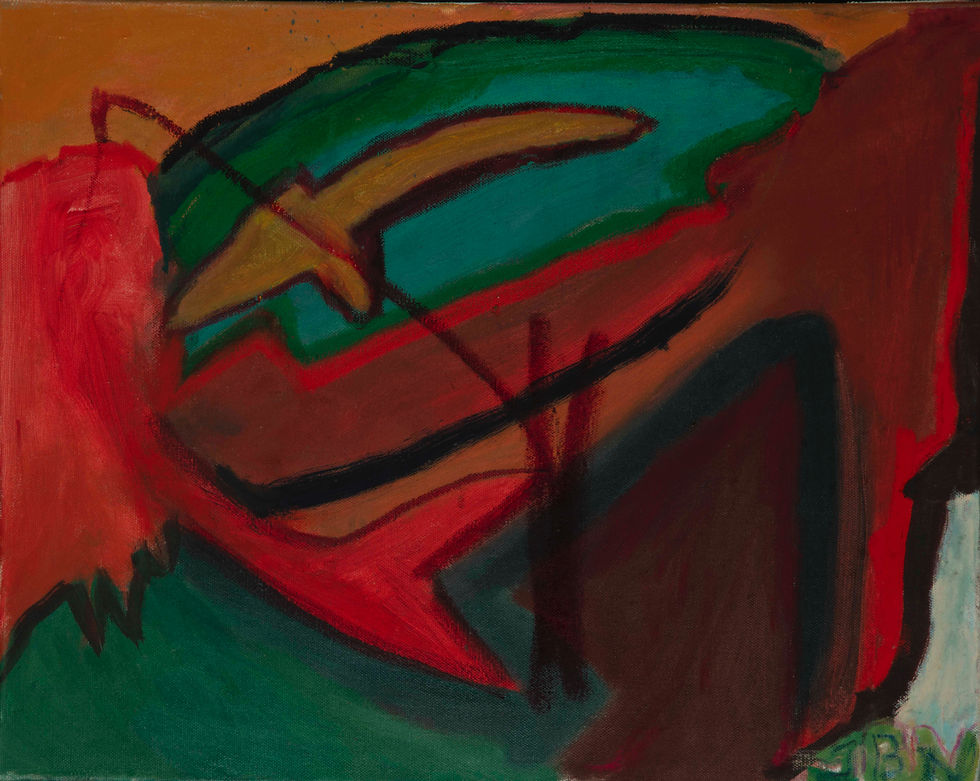

Texts, photographs, conversations and artworks also reveal the sweet affinities that enriched his life — Ducati motorbikes, fencing, and languages (spoken without accent). His ease with language sometimes surfaced in his drawings with a playful, provocative, and at times disdainful edge.
With stubborn energy, what followed was a remarkable renaissance post‑injury, willed on by wife Thessy who, vowing that he would keep his art, brought to his hospital bed — as soon as he could hold objects — the tools of his trade: paper, pencils, wax crayons, and oil pastels. She supported his efforts to relearn his languages, and together they rekindled their shared affection for foreign tongues, often mixing them within a single sentence. In this state of reawakening, he discovered a new sense of artistic freedom.
His brushstrokes returned, evolving from near‑childlike sketches into works that, in later years, equal, and even surpass, the emotional force of those from his earlier life.
Nichols’ rehabilitation was not easy. He renounced painting figures after being unable to reproduce a favourite figurative work from before. Painting with oils was also no longer an option.
Despite these challenges, the couple’s emotional chemistry reopened the gateway to his life’s calling. Remembrance found its way through the layers of their enduring bond.
'Life of Joel' — a singular reflection on the body of work by Nichols and curated by Thessy Schoenholzer Nichols, is showing at Galerie B, Bäumleingasse 9, 4051 Basel, 12–21 June 2026. Contact +41 79 532 0764.
In support of ‘Life of Joel’ –– the exhibition and the catalogue –– we are also releasing a short film in which Thessy speaks to camera, recounting the life of her late husband and the path that led to this retrospective. Her storytelling is unguarded, tender, and profoundly real — she invites the viewer into the deeper, more intimate layers of Joel’s paintings: the landscapes, the play of colour, the influences of earlier Expressionist traditions, and those fusions of terrain and surreal form that became known as his “landshapes.” The exhibition brings together the paintings that trace the fragile and determined arc of his recovery, and Thessy describes the intent behind his work, contextualising and shaping the narrative in line with Joel’s own thoughts, anguishes, and wishes. The film stands as both a tribute and a fulfilment of his long‑held ambition to exhibit at the world‑renowned Beyeler, formerly located on Bäumleingasse in Basel, where his body of work was, in June 2026, beautifully brought together.
View the film 'LIFE OF JOEL' below:


Beautiful article on Joel.
Formidable!